




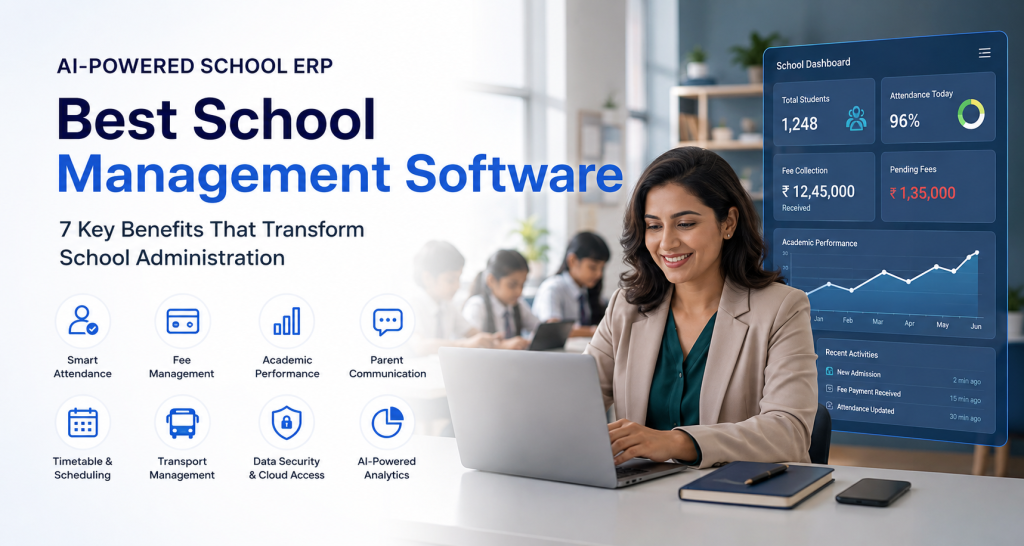
If you run a school, you already know what the morning looks like. Attendance is being marked in a register or a shared spreadsheet. The accounts team is chasing three parents about overdue fee payments. A parent is calling the front desk asking for a progress report that should have gone out last week. Two teachers are filling in duplicate forms for the same student. And somewhere in the admin room, there are five Excel files that don’t talk to each other.
This isn’t a management failure. It’s what happens when schools grow faster than their systems. The best school management software exists to fix exactly this — not by adding another tool to the pile, but by replacing every disconnected process with one connected platform that runs the whole operation.
Here’s what that shift actually looks like for schools.
Why the Best School Management Software Outperforms Manual Systems
Most school administrators aren’t short on effort. They’re short on systems. When attendance lives in one place, fees in another, and parent communication happens across WhatsApp, email, and phone calls, the school is constantly playing catch-up.
The best ERP for school changes this by centralizing every operation. Attendance, fee records, academic results, staff schedules, parent communication — all in one platform, updated in real time, accessible from any device. When a fee is paid, every department sees it immediately. When a student is absent, parents know within minutes. The school stops running on what someone remembered to update and starts running on accurate, live data.
That’s the core difference between manual systems and a cloud-based school ERP. One requires your staff to coordinate information manually across tools. The other does it automatically.
1. Does Your Attendance Process Actually Save Time?
Daily attendance tracking consumes more staff time than most schools realize. Across hundreds of students, manual roll calls, physical registers, and end-of-month reconciliations add up to a significant administrative burden.
A school management system captures attendance through biometrics, RFID cards, or a mobile check-in. The moment a student is marked absent, parents receive an automatic notification — no calls, no delays. Attendance data flows directly into academic reports and compliance records. In 2025, a Gallup-Walton Family Foundation survey found that teachers using AI-powered tools save an average of 5.9 hours per week. Attendance automation is one of the fastest places that saving shows up.
2. Why Do Schools Still Struggle with Fee Collection?
Fee collection is one of the most staff-intensive tasks in school administration. Sending reminders, tracking partial payments, updating ledgers manually, and reconciling records at month-end takes hours that should be spent elsewhere.
The best school management software automates the entire cycle. Payment reminders go out on schedule. Parents pay through a secure online portal. Receipts are generated instantly. Accounts are reconciled automatically. In 2026, research from found that digital fee systems reduce collection time by 60–80% and improve on-time payments by 45%. Month-end stops being a scramble and becomes a routine check.
3. Academic Performance Tracking in Real Time
When a student’s grades start declining, the best time to act is early — not at the end of term when it’s already too late for intervention. Manual systems surface this information weeks after the fact. A live academic dashboard changes that.
Teachers and principals see grade trends, assignment completion rates, and assessment results as they happen. If a cohort is underperforming in a particular subject, leadership knows within days — not at the next review meeting. Resources get directed where they’re needed. Decisions get made on data, not instinct.
4. Parent Communication That Doesn’t Require a Full-Time Coordinator
Schools shouldn’t need a dedicated staff member just to respond to parent queries. A parent portal or mobile app sends attendance alerts, fee receipts, event notices, and report cards automatically — without anyone drafting individual messages.
Parents get consistent, real-time updates about their child’s school day. Front desk call volumes drop. Walk-in queries decrease. And because communication is proactive rather than reactive, parent trust in the school increases noticeably over time.
5. How Much Admin Work Can a School ERP Actually Automate?
Running a school involves dozens of operational tasks that consume admin staff time daily — timetable generation, substitute scheduling, exam hall allocation, staff leave management, transport routing, library records. None of these require a principal’s judgment. All of them require a reliable system.
When the best ERP for school handles these workflows, your admin team stops managing routine tasks and starts managing exceptions only. As the school grows — new batches, new branches, increased intake — the platform scales without requiring proportional growth in administrative headcount.
6. Secure, Cloud-Based Data Management
Student records, fee histories, staff information — this data needs to be protected and always accessible. Cloud-based school ERP platforms use encrypted storage, role-based access controls, and automated daily backups. Staff access only what their role requires. Every action is logged. Compliance reports can be exported at any time.
And because the data is hosted in the cloud, a local hardware failure or power outage doesn’t put your records at risk.
7. Compliance Reporting Without the Year-End Panic
Board submissions, affiliation filings, annual academic summaries — these reports take days to compile when data is scattered across systems. With a connected school ERP, the data is always current and organized. Reports are generated in minutes.
Principals walk into every review, audit, or board meeting with accurate numbers rather than estimates. Academic analytics also give leadership a clear view of cohort-level trends — which grades need attention, which subjects have high failure rates, where early intervention is overdue.
Features to Look for in the Best School Management Software
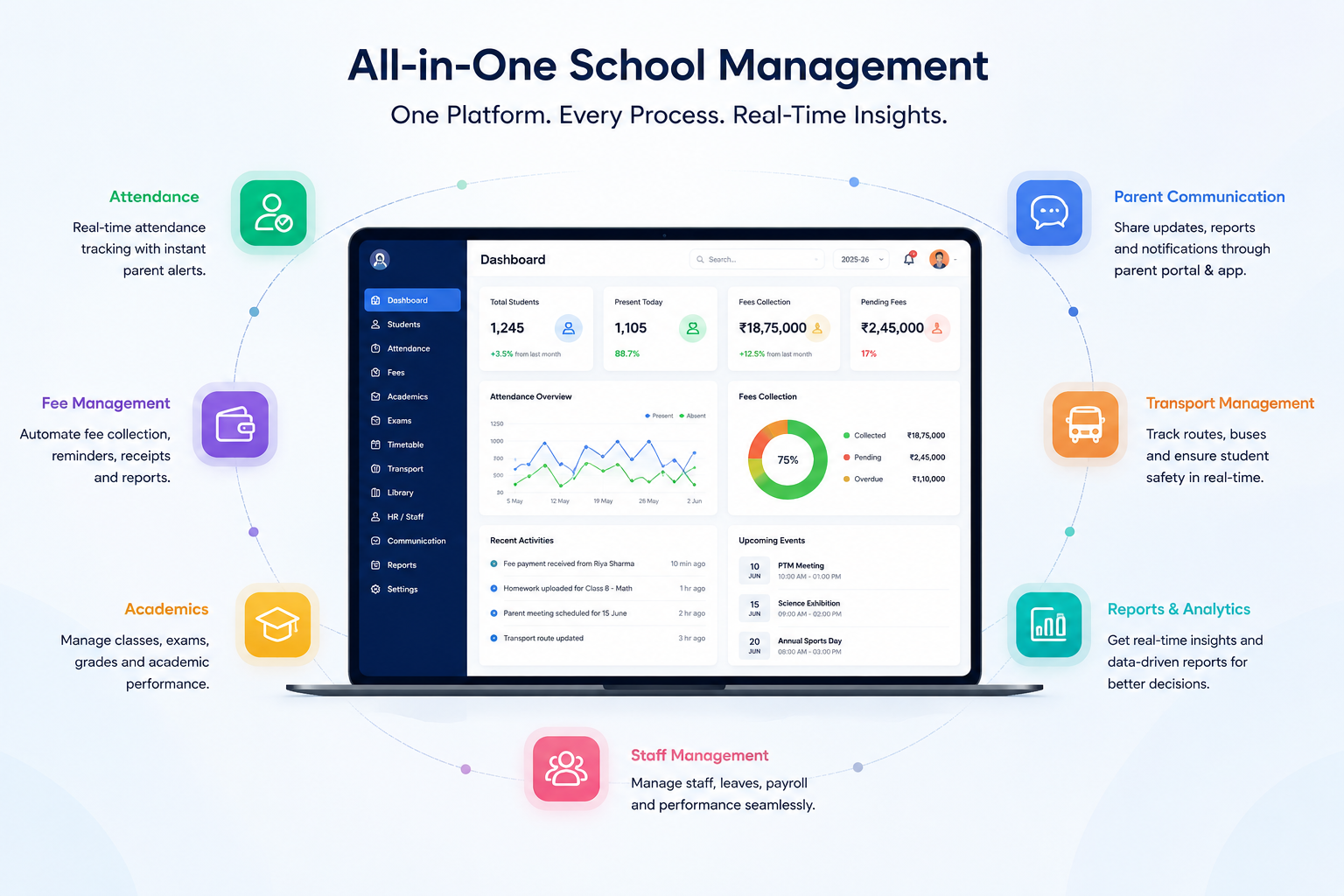
Not every platform delivers the same capabilities. When evaluating school management software, these are the core features that matter:
- Mobile app — for staff, parents, and leadership on the go
- Cloud access — data accessible from any device, from anywhere
- Fee management — online payments, automated reminders, instant reconciliation
- Attendance tracking — biometric, RFID, or mobile-based with real-time parent alerts
- Parent communication portal — automated updates, notifications, and report sharing
- Timetable management — automated scheduling with substitute and exam management
- Analytics dashboard — live academic and operational data for decision-makers
If a platform requires third-party tools to cover any of these, you’ll end up with the same fragmentation you were trying to solve.
Ready to Move Beyond Spreadsheets?
If your school is still running on manual registers, Excel sheets, and WhatsApp follow-ups, a cloud-based school ERP is the most direct path to fixing that. brings all the features above into a single platform built specifically for school operations — no IT team required, no long setup process.
Frequently Asked Questions
What is the best school management software for Indian schools?
The best school management software for Indian schools should support CBSE/state board compliance, regional language communication, online fee collection, and multi-branch management. Cloud-based platforms built for the Indian school market cover these requirements out of the box.
What is the difference between school management software and a school ERP?
School management software covers student-facing functions like attendance and grades. A school ERP integrates those with finance, HR, transport, and operations in one system. The best ERP for school combines both so nothing requires a separate tool.
Is cloud-based school ERP software safe for student data?
Yes. Reputable platforms use encrypted storage, role-based access controls, and automated backups. Data is significantly more secure and recoverable than local servers or spreadsheets — and accessible even if on-site hardware fails.
The Right Time to Make the Switch
Schools that run on disconnected systems aren’t just working harder — they’re leaving efficiency on the table every single day. The best school management software doesn’t add more complexity. It removes the friction that already exists: the missed communications, the fee follow-up calls, the duplicate data entry, the end-of-term report scrambles.
If your school is ready to move from reactive administration to one that runs on accurate, real-time information, a cloud-based school ERP is the practical next step. Explore what offers — from attendance and fee management to academic analytics and parent communication — all in one place.